XFEL: Core-shell jets increase liquid sample delivery stability
Core-shell jets increase liquid sample delivery stability
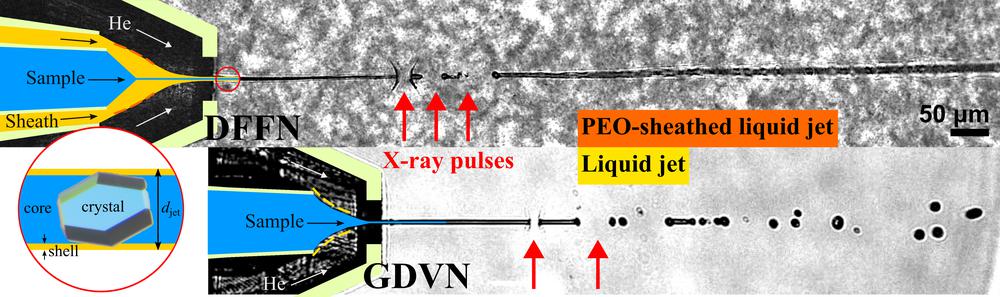
Microscopy images taken at the SPB/SFX instrument, showing a 4 micrometre-wide (about a tenth of a human hair) compound jet generated by a double-flow focusing nozzle (DFFN) that uses a PEO solution as the jet shell (top) and a conventional liquid jet (bottom) from a gas dynamic virtual nozzle (GDVN). The jets have a velocity of ca. 47 m/s (170 km/h) and are hit by the X-ray pulses (red arrows) that arrive at a 1.1 MHz repetition rate. The extended jet lengths have the potential to allow for long pump-probe delays in time-resolved studies. (Illustration: European XFEL)
Typically, liquid jets are generated by gas dynamic virtual nozzles, which are continuously improved and manufactured at European XFEL before being provided to user experiments at the SPB/SFX instrument. They use an outer stream of helium to compress and accelerate the liquid containing the microcrystal samples into a jet of a few micrometers in diameter. Double-flow focusing nozzles additionally use a sheath solution between the crystal stream and the helium. The scientists now added a low concentration of polyethylene oxide (PEO), a bio-compatible polymer, to this aqueous sheath. This produced a viscoelastic jet: The PEO makes the sheath liquid behave partly like a viscous fluid, as the stretched polymer chains form a stabilizing ‘armor’ around the sample stream and generate a long, steady jet.
The key aspect of the stabilization is “the intense converging extensional flow at the ejection point triggers a coil-stretch transition of the polymers inside the micronozzle, thereby building up large extensional viscoelastic stress. This stress does not relax in the jet even for times much longer than the polymer relaxation time. The increased extensional viscosity confers superstability on the jet”, says co-author José María Montanero, Professor of Fluid Mechanics at the Universidad de Extremadura.
Due to their millimeter length, such core-shell jets can even be considered for pump–probe SFX in order to access a timescale of a few tens of microseconds. This range is in between the previously achievable ranges accessible at XFELs (picoseconds-to-microsecond time delays) and synchrotrons (a few hundred microseconds to millisecond delays), and has so far been considered a blind spot.
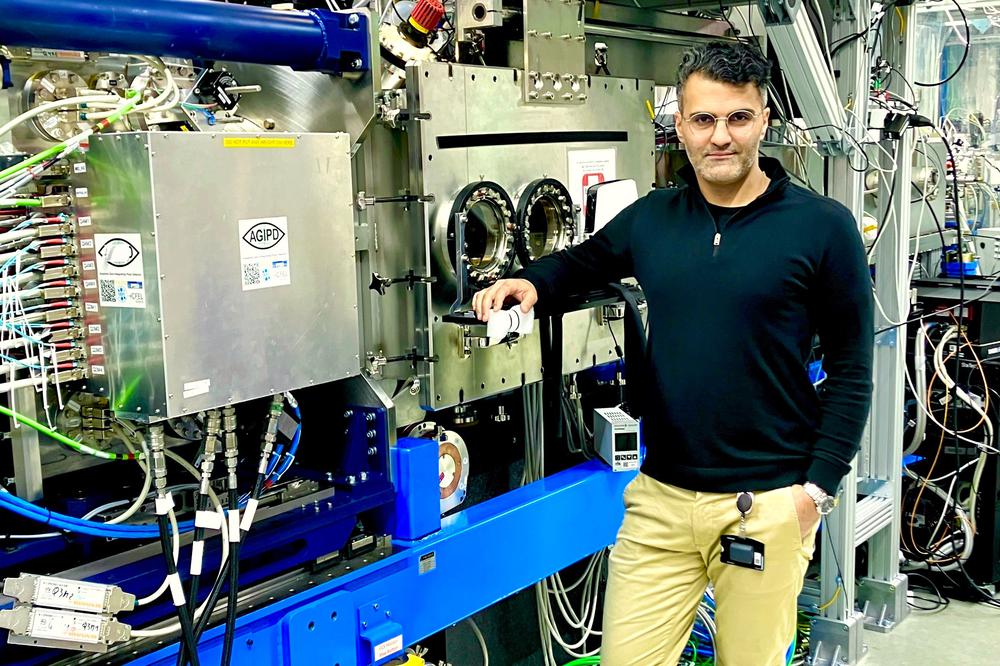
Beamline scientist Mohammad Vakili at the SPB/SFX instrument of European XFEL, where the experiments were carried out. (Photo: European XFEL)
The researchers also developed novel triple-flow focusing nozzles that introduce the described benefits to microfluidic mixing-nozzles, thus paving the way for time-resolved studies of samples that have to reside in viscous buffers. Petra Fromme, Professor in the School of Molecular Sciences, Arizona State University, says: “Viscoelastic jets represent an efficient method to deliver samples that are dispersed in both low-viscosity and medium-viscosity liquids. Finally, we may have found an injection method that caters to challenging-to-jet liquids, such as photosystem II crystal media.” Photosystem II is a protein complex that plays a key role in photosynthesis and is at the centre of many research projects.
The multidisciplinary work —which spans X-ray diffraction methods, fluid dynamics, polymer science, and structural biology —involved close collaboration between European XFEL, the Universities of Extremadura, Sevilla and Hamburg, the Arizona State University, and Deutsches Elektronen-Synchrotron (DESY) in Hamburg.
Original Publication: https://doi.org/10.1038/s41598-026-44308-8

