XFEL: 3D printing enables customised sample delivery
3D printing enables customised sample delivery
The extremely fine X-ray laser beam of the European XFEL, consisting of ultrashort pulses, enables researchers to study a wide variety of samples—from atoms and molecules through protein crystals, viruses, and cells to solids, liquids, and gases—with highest temporal and spatial resolution. A prerequisite for this is the precise delivery of the samples into the X-ray beam, tailored to the respective experiment. To this end, the Sample Environment & Characterization (SEC) group at European XFEL has developed various devices for liquid sample injection that can be produced in large numbers by means of 3D printing. In order to advance the field worldwide, the SEC group has published the corresponding 3D designs today in the Journal of Synchrotron Radiation.
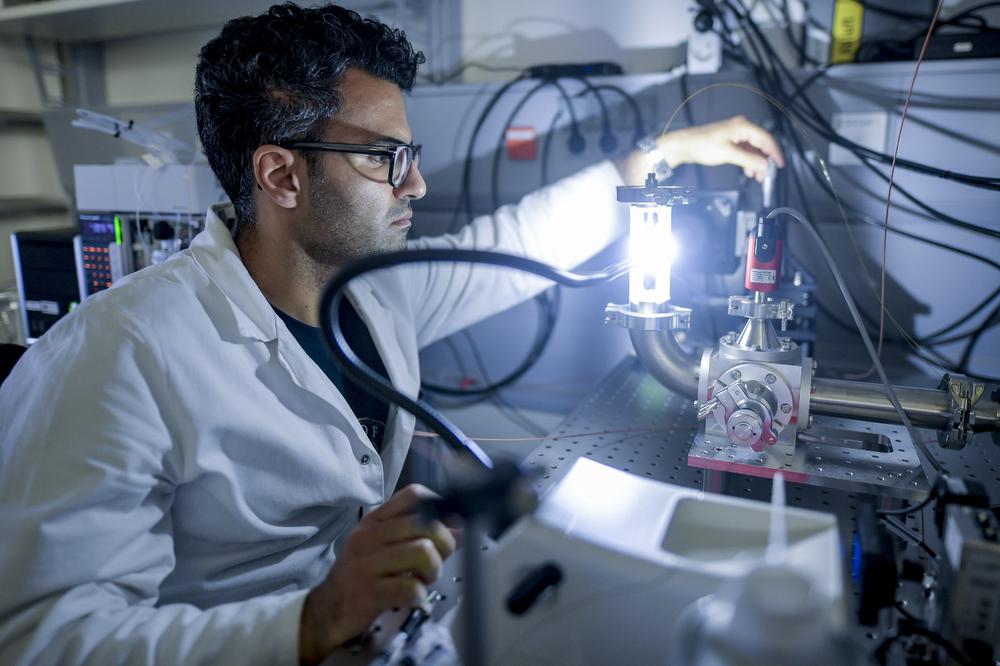
A nozzle is tested in the lab by European XFEL scientist Mohammad Vakili. European XFEL/Axel Heimken
Sample delivery at the European XFEL is a great challenge because of its high repetition rate: The X-ray laser delivers up to 27 000 pulses per second, but in individual pulse trains in which the repetition rate can be up to 4.5 million per second. The often tiny samples have to be introduced into the X-ray beam, which is only a few millionths of a metre thick, so precisely that it actually hits them. Moreover, due to the high peak power, a single X-ray pulse is often enough to destroy the sample. It is therefore important to develop methods that ensure a continuous supply of samples compatible with these high repetition rates.
For this purpose, the SEC group relies on modern 3D printing based on so-called two-photon polymerization. This allows new design ideas to be quickly turned into prototypes and the sample delivery devices that have proven themselves in practice to be fabricated quickly and reproducibly in large numbers. Geometric features, such as the diameter of microchannels or the spacing between nozzle apertures, can also be conveniently varied. 3D printing thus enables nearly unlimited design flexibility, thanks to which the sample delivery devices can be customized for each experiment. For example, the SEC group now supplies various micronozzles, mixers, or electro-sprayers that allow rapid delivery of a variety of samples in liquids, highly viscous media, or aerosol-based environments into the X-ray beam.
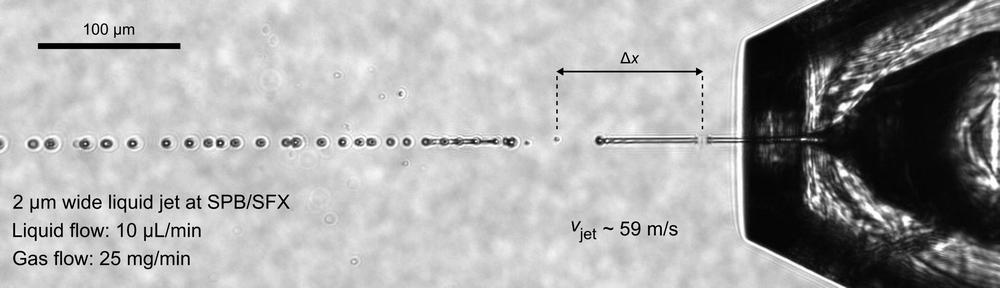
Microscopy image of a 2 µm wide liquid jet produced by a Gas Dynamic Virtual Nozzle.
After two successful experiments using the new 3D-printed sample injectors at the European XFEL, Richard Neutze, Professor of Biochemistry at the University of Gothenburg in Sweden, says: “In our two experiments at the European XFEL, the SEC group supported us with both viscous-media injectors for serial crystallography and liquid injectors for single-particle imaging. The use of the very accurate 3D printing technologies provided valuable flexibility and reliability for both types of experiments.”
Orignial publication: https://doi.org/10.1107/S1600577521013370
Further information on the sample delivery devices: https://www.xfel.eu/organization/scientific_and_technical_groups/sample_environment/projects/liquids/index_eng.html

