Duration: 9 a.m. – 2 p.m.
Number of students: Up to 32
Target group: Senior secondary students
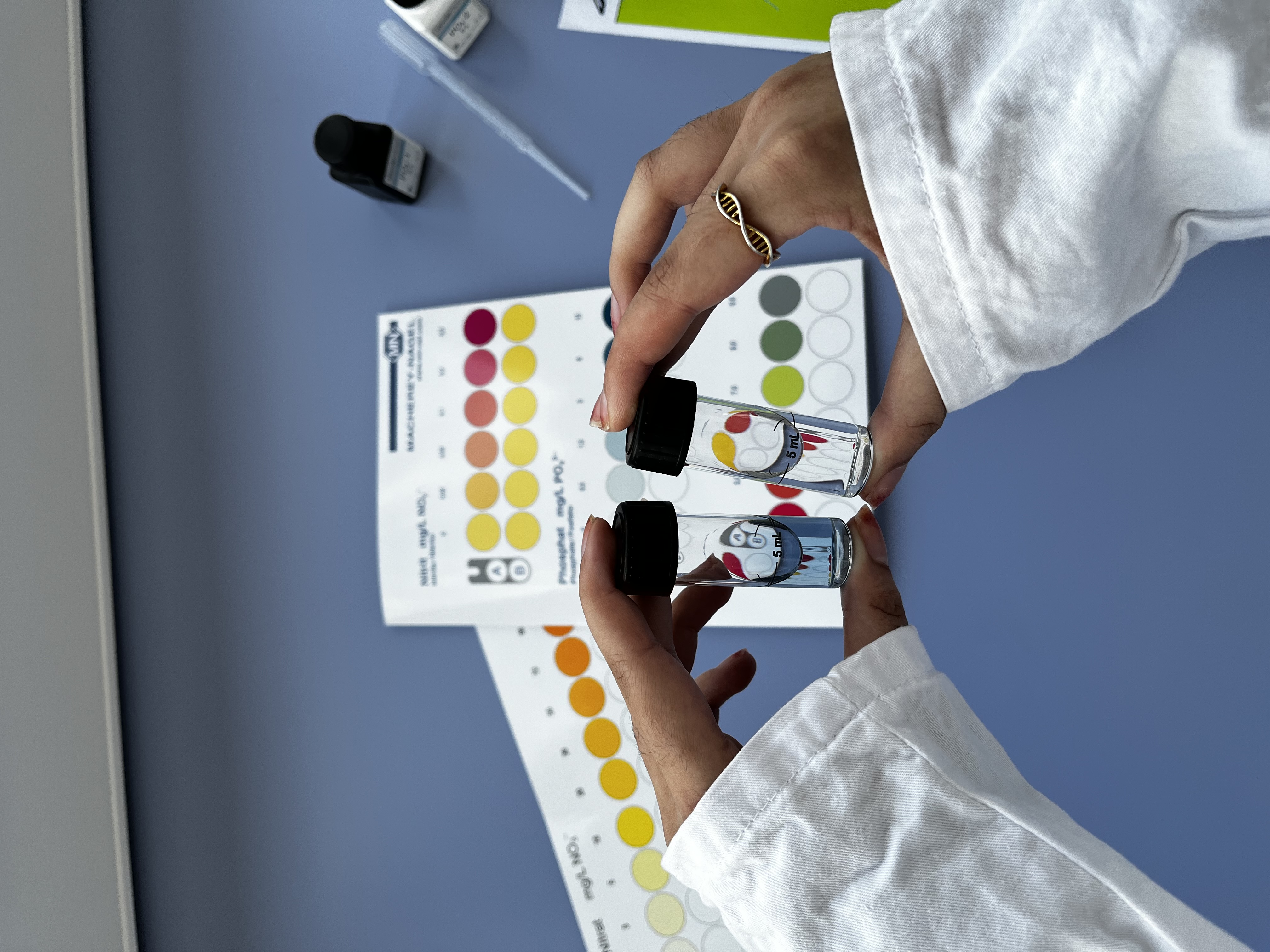
In this course, students acquire key skills in scientific knowledge acquisition by examining water samples. They first analyse selected constituents using colorimetric test kits and compare these semi-quantitative results with precise measurements using UV/VIS spectrophotometry after creating a calibration curve. In doing so, they reflect on the significance, accuracy and limitations of various measurement methods. The experimental work is embedded in an ecological context by addressing the causes and consequences of overfertilisation of aquatic ecosystems and their significance for the environment and humans.
Laboratory activities
- Pipetting with the microlitre pipette
- Performing a colorimetric test
- Measurements with the UV/VIS spectrophotometer
Relevance to subject requirements
- Ecology: Aquatic ecosystems, material inputs, eutrophication
- Scientific working methods and modelling
- Sustainability and environmental assessment
Recommended prior knowledge
- Fundamentals of aquatic systems ecology - Knowledge of the structure and function of aquatic ecosystems, material cycles (especially nitrogen and phosphorus) and basic relationships between nutrient inputs and eutrophication.
- Basic concepts of chemistry in a biological context - Understanding of substance concentrations (e.g. mg/L), solutions, dilutions and simple chemical reactions as they occur in detection reactions.
- Scientific working methods - Experience in planning and conducting experiments, in the safe use of laboratory equipment and in recording, evaluating and interpreting measurement results.
- Basic understanding of physical measurement principles - Elementary knowledge of light absorption, wavelengths and the relationship between absorption and substance concentration as a prerequisite for working with photometric measurement methods.