XFEL: More than just viscous: researchers examine movement of proteins
More than just viscous: researchers examine movement of proteins
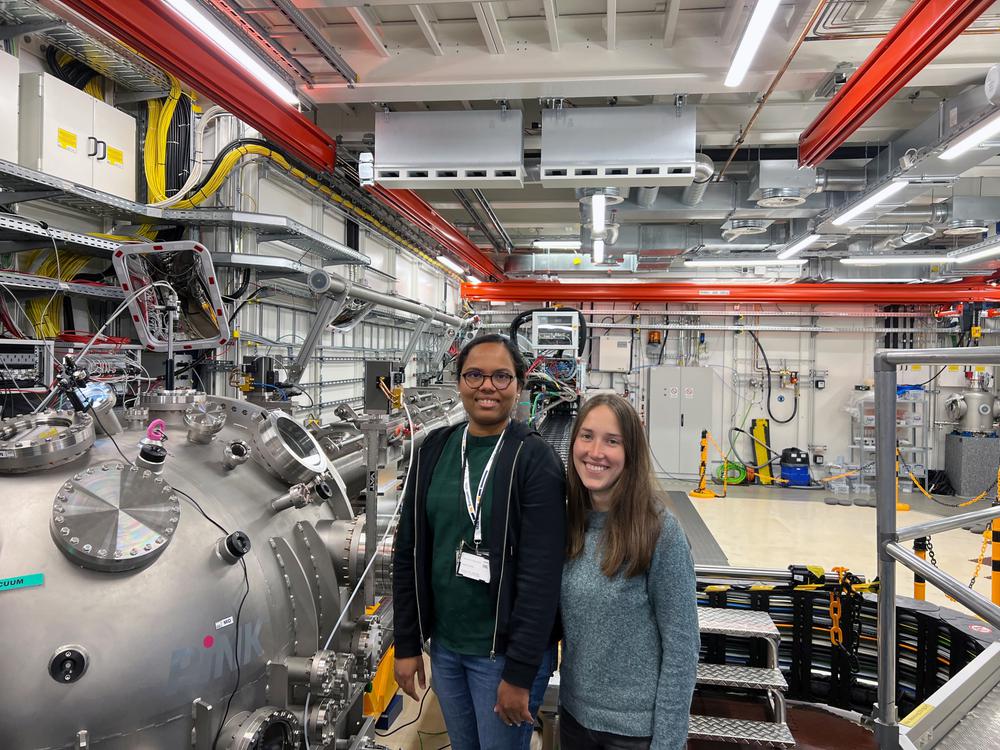
Co-authors Michelle Dargasz (right) and Nimmi Das Anthuparambil at the 'Materials Imaging and Dynamics' (MID) instrument at the European XFEL, where the experiments were carried out. (Photo: University of Siegen)
“Conducting research at European XFEL was a fantastic opportunity and a wonderful experience. As proteins are very small – we’re talking in the nanometre range here – short-wavelength X-rays are well suited to studying them,” says Michelle Dargasz, lead author of the study and a PhD student working with Christian Gutt, Professor of Solid-State Physics at the University of Siegen.
Proteins perform vital tasks within cells: they control chemical reactions, transmit signals and interact with other proteins. For this to work, they must move through the densely packed interior of the cell. It is well known that the viscosity of the surrounding environment influences the movement of proteins. However, the study by Dargasz and her colleagues shows that other effects also play a decisive role.
For their experiments, the researchers used the protein ferritin, which is found in almost all living organisms and stores iron. They added various substances to the aqueous protein solution to mimic the dense interior of a cell – ranging from small sugar molecules to large, branched polymer molecules.
At European XFEL, the researchers were able to track the movement of the proteins using high-resolution megahertz X-ray photon correlation spectroscopy. This technique reveals how the proteins move within millionths of a second. “The very high repetition rate of X-ray pulses in European XFEL's burst mode make it possible to observe precisely the short timescales over which proteins move in a densely packed environment,” explains Johannes Möller, a scientist at the MID instrument at European XFEL.
The measurements show that the added molecules do not merely alter the viscosity of the solution. They also influence how the proteins arrange themselves in relation to one another: due to the presence of the molecules, the proteins attract one another and temporarily assemble into small complexes of two to three proteins. After a short time, they separate again, only to reassemble elsewhere. When bound into such complexes, the proteins move slightly more slowly than when they are on their own.
“The size and shape of the molecules that mimic the cell’s interior determine the extent to which proteins organize themselves on the smallest scale,” explains Michelle Dargasz. “In doing so, they also influence the extent to which the collective movement of the proteins is affected.”
Another finding was particularly surprising: individual proteins do not simply slow down as the density increases. “Our results show that the movement of proteins does not depend solely on how viscous their environment is,” says Professor Christian Gutt from the University of Siegen, who led the study. “At low concentrations of polymer molecules, we see instead that the proteins can initially move even more freely before the slow-down effect of viscosity sets in – a behaviour that has not been observed in this way before.”
The new findings help to shed light on the processes taking place inside living cells. They provide a more realistic picture of how proteins move and interact with one another under natural conditions. In the long term, the findings could help to better explain fundamental biological processes – such as protein interactions or enzyme activity. Such insights could, for example, help to improve the administration of medicines for certain diseases in the future.
The study involved researchers from the Universities of Siegen, Tübingen and Stockholm, the TU Dortmund, as well as the German Electron Synchrotron (DESY) and European XFEL. The research project was funded by the German Federal Ministry of Research, Technology and Space (BMFTR) as part of the ErUM-Pro programme. The data processing workflow used was developed as part of the DAPHNE4NFDI initiative in accordance with the FAIR data principles.
Original publication: https://doi.org/10.1073/pnas.2524733123

