XFEL: How electrons actually behave in warm dense matter
How electrons actually behave in warm dense matter
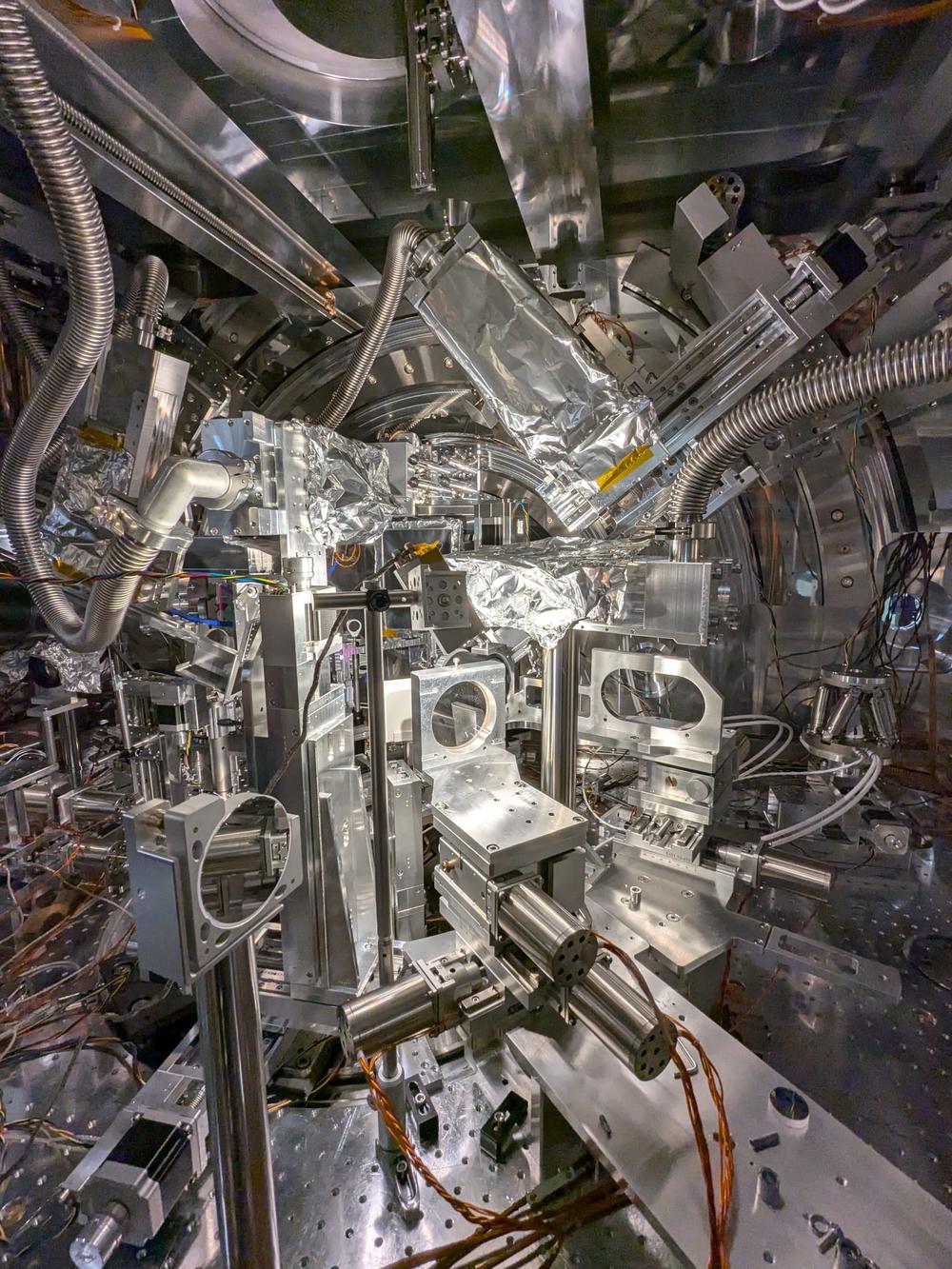
Experimental setup at the HED-HIBEF instrument (Photo: European XFEL)
In warm dense matter, electron density oscillates. The collective oscillations are called plasmons. They carry important information and can be observed using X-rays, resulting in scattering spectra – abstract images captured by a detector. In many experiments, these spectra are interpreted using simplified uniform electron gas models. However, the new measurements show that, for warm dense aluminium, these models consistently overestimate the plasmon energy by up to about 25 per cent (about 8 electronvolts) and fail to reproduce the full measured shape of the signal.
“Our measurements are precise enough to clearly distinguish between competing models,” says Thomas Preston of European XFEL. “That is important because these models are widely used to diagnose extreme states of matter. If the model is incorrect, that leads to inaccurately inferred properties.” The electron behaviour affects predictions of opacity, optical properties, electrical conductivity, and energy transport, for instance.
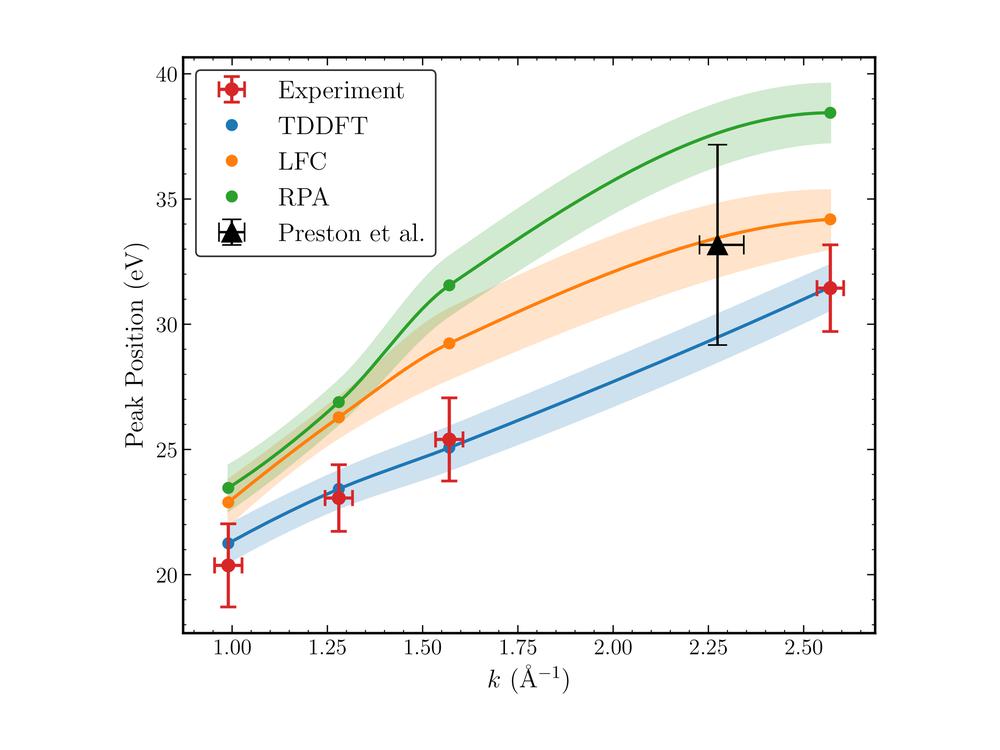
X-ray measurement of collective electron oscillations in shock-compressed aluminium. The measured plasmon energies (red) agree with time-dependent density functional theory (TDDFT, blue), while simpler electron-gas models (LFC and RPA, orange and green) overestimate the energy. (Illustration: European XFEL)
“Even for aluminium, often treated as a simple metal, the electron response is not described well by overly uniform models once the material is driven into this extreme regime,” says Dmitrii Bespalov, first author of the study. “Only when we account for the real disordered structure do theory and experiment agree.” The same experimental approach can be extended to other materials and to higher temperatures, including conditions relevant to planetary interiors and fuel targets used for laser fusion.
The experiment was conducted at the high energy density instrument (HED-HIBEF) at European XFEL, using the powerful nanosecond DiPOLE laser. The laser compressed a thin aluminium foil to a pressure of around 50 gigapascals (500,000 times atmospheric pressure) and a temperature of approximately 7000 Kelvin (about 6700 degrees Celsius). Before the shock wave broke out of the rear surface of the aluminium, ultrashort X-ray pulses from the European XFEL probed the sample and recorded the plasmon signal. Using multiple methods simultaneously – X-ray Thomson scattering, X-ray diffraction, and independent shock diagnostics – enabled the researchers to benchmark theory against a well-constrained experimental state. Scientists from more than a dozen international institutions contributed to the study.
Original publication: https://link.aps.org/doi/10.1103/86cw-8wm5

