XFEL: Chemical shifts help track molecules breaking apart in real time
Chemical shifts help track molecules breaking apart in real time
When molecules fall apart, their electric charge doesn’t stay put—it rearranges as bonds stretch and break. An international team of scientists has now tracked these ultrafast changes in the small molecule fluoromethane (CH₃F). It was the first time that the Small Quantum Systems (SQS) instrument at European XFEL could deliver detailed insights into transient states during chemical reactions. These intermediate states, that only exist temporarily while the reaction is ongoing, are often the key drivers of chemistry and therefore crucial to understand. Over the long term, that kind of insight can support progress in areas such as atmospheric science (where sunlight-driven reactions and fragmentation pathways shape air chemistry), as well as the study of complex molecular systems including biomolecules and proteins, where local excitation and charge transfer can trigger structural change.
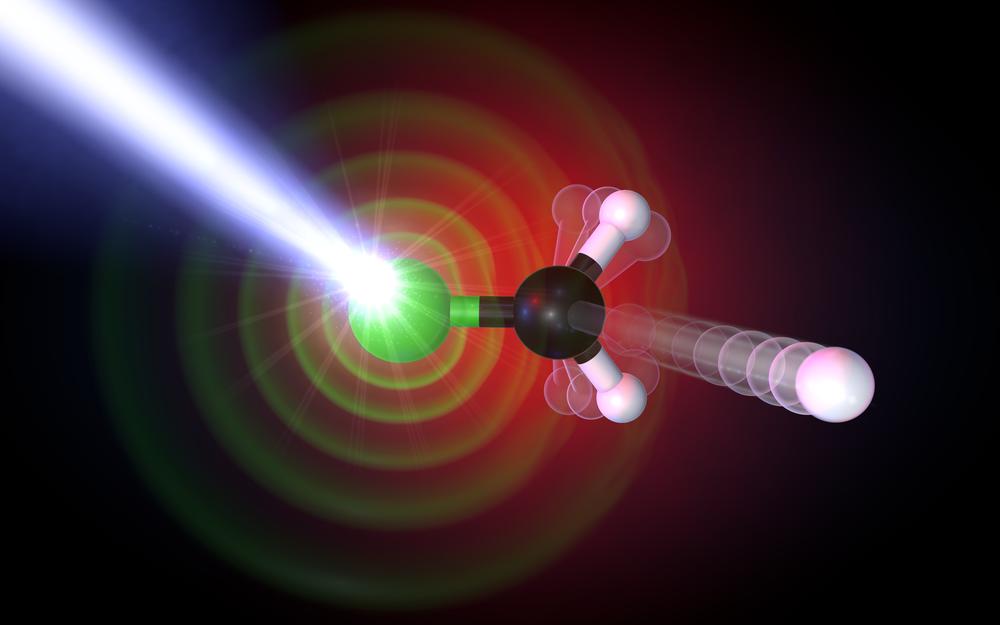
Illustration of the pump–probe experiment on fluoromethane (CH₃F): Shortly after an ultrashort optical laser pulse (red) has ionized the molecule and triggered bond breaking, a femtosecond X-ray pulse (blue/white) ejects a core electron (green clouds) from the fluorine atom (green ball). By measuring the electron's kinetic energy, the experiment tracks time-dependent 'chemical shifts' that reveal how the local electronic environment changes as the molecule dissociates - in this case the departure of a hydrogen atom (white ball). (Illustration: European XFEL)
“Core-level photoelectron spectroscopy tells us what is happening at a specific atom,” says Michael Meyer, lead scientist at the Small Quantum Systems (SQS) instrument at European XFEL. “By probing carbon and fluorine independently, we can see when different fragments appear and how the charge distribution evolves during dissociation.
Two competing break-up pathways
The measurements reveal that after ionization through the loss of an electron, fluoromethane can dissociate through different channels on very different timescales. One channel involves rapid cleavage of the C–F bond, forming a CH₃⁺ fragment and a departing fluorine atom. A second channel is slower and involves C–H bond cleavage, producing CH₂F⁺ and a neutral hydrogen atom. “Knowing not only the starting molecule and the final fragments, but also the short-lived intermediate states, is key,” says Daniel Rivas, former instrument scientist, now guest scientist at SQS and first author of the research paper published in Physical Review X. “Those transient species can be highly reactive and may be the real drivers of chemical change.”
From measurement to mechanism
A central challenge in ultrafast XPS is interpretation: the experiment directly measures shifting spectral lines, but identifying which transient species causes which line and what that implies about charge motion, requires theory. To connect the observed chemical shifts to the molecular dynamics, the team used advanced simulations. They also compared these results with a simpler “partial-charge” (electrostatic) model that estimates chemical shifts from the evolving distribution of partial charges on the atoms. “Explicit core-hole calculations can be very complex and computationally expensive,” says Antonio Picón (Instituto de Ciencia de Materiales de Madrid, CSIC), one of the project’s principal investigators. “Here we show that a much simpler partial-charge model can reproduce the key chemical shifts with very good agreement, which could make it far easier to analyze ultrafast XPS data in larger, more complex systems.”
The study also highlights that chemical shifts can be influenced not only by the atom being probed, but also by charges located surprisingly far away, for example as fragments separate and move out of each other’s electric field. This long-range sensitivity is one reason the approach is promising for tracking charge-driven dynamics in larger molecular structures.
Transient products drive reactions
Many reactions are governed not just by the final products, but by transient states that exist for only femtoseconds to picoseconds. By making those intermediates experimentally accessible, time-resolved XPS can help decipher “what drives what” during chemical change. Improved understanding of highly reactive intermediates is a foundation for learning how to better manage and control photochemical reactions, for example by choosing excitation conditions that favor or suppress specific reaction pathways.
“For us at SQS, this was a first time-resolved experiment in this configuration using the optical laser,” Meyer adds. “It served as a proof of concept, showing that we can run stable pump–probe measurements and extract rich, site-resolved dynamics from the spectra.”
Original Publication: https://doi.org/10.1103/y6dt-1sfw

